Disclaimer: This blog may contain information, excerpts, or materials collected from various websites and other sources for educational, learning, and research purposes. Some content may be quoted, summarized, or reproduced to help share useful knowledge and information with readers. I do not claim ownership of content created by others, and all rights belong to their respective authors, publishers, and copyright holders. Whenever possible, credit and links to the original source are provided
YOUR PATIENT IS AT RISK for OSA - OBSERVE WHILE PATIENT ASLEEP.
If stop bang is greater than or equal to 3 - patient AT RISK for Obstructive Sleep Apnea (OSA).
If stop bang is greater than or equal to 5 - patient AT HIGH RISK for Obstructive Sleep Apnea (OSA)
Introduction. Obstructive sleep apnea (OSA) is characterized by episodes of a complete (apnea) or partial collapse (hypopnea) of the upper airway with an associated decrease in oxygen saturation or arousal from sleep. [1] This disturbance results in fragmented, nonrestorative sleep.
What causes OSA?
Anything that could narrow your airway such as obesity, large tonsils, or changes in your hormone levels can increase your risk for obstructive sleep apnea.
Central sleep apnea happens when your brain does not send the signals needed to breathe.Mar 24, 2022
Can you fix sleep apnea?
In some cases, sleep apnea can resolve if you return to a healthy weight, but it can recur if you regain the weight. Exercise. Regular exercise can help ease the symptoms of obstructive sleep apnea even without weight loss. Try to get 30 minutes of moderate activity, such as a brisk walk, most days of the week.Apr 6, 2023
What is the best position to sleep in with sleep apnea?
Snoring and sleep apnea: Obstructive sleep apnea causes the airways to collapse during sleep, leading to pauses in breathing. It often goes hand-in-hand with snoring. Positioning yourself on your side or stomach can help the airways stay open to reduce snoring and alleviate mild apnea, Salas says.
5 Sleep Apnea Treatment Options
Oral Appliances. Just as there are dental professionals who specialize in orthodontics or dental implants, there are also those who can help with sleep apnea. ...
Oral Surgery. In some cases, genetics can be the cause of sleep apnea. ...
copy from above mentioned website for learning purposes
Written by
Jay Summer, Staff Writer
Medically Reviewed by
Dr. Abhinav Singh, Sleep Physician
Positive airway pressure (PAP) is one of the most common treatments for sleep apnea, a breathing disorder that affects approximately 10% to 30%Trusted SourceUpToDateMore than 2 million healthcare providers around the world choose UpToDate to help make appropriate care decisions and drive better health outcomes. UpToDate delivers evidence-based clinical decision support that is clear, actionable, and rich with real-world insights.View Sourceof the population. The most common PAP treatment is continuous positive airway pressure (CPAP), but bilevel positive airway pressure (BiPAP or BPAP) may be a better option for some people.
While both forms of PAP therapy work in similar ways, their differences mean that each has distinctive benefits and drawbacks to consider. Because of this, the decision to switch PAP treatments should always be made under the advice of your health care team.
What Is the Difference Between CPAP and BiPAP Machines?
CPAP and BiPAP machines are both forms of positive airway pressure therapyTrusted SourceNational Library of Medicine, Biotech InformationThe National Center for Biotechnology Information advances science and health by providing access to biomedical and genomic information.View Source, which uses compressed air to open and support the upper airway during sleep. A portable machine generates the pressurized air and directs it to the user’s airway via a hose and mask system. Both systems use similar masks, hoses, and other accessories.
In general, CPAP machines have an adjustable pressure setting that delivers between 4 to 20 cm H2OTrusted SourceUpToDateMore than 2 million healthcare providers around the world choose UpToDate to help make appropriate care decisions and drive better health outcomes. UpToDate delivers evidence-based clinical decision support that is clear, actionable, and rich with real-world insights.View Source(a measure of air pressure that stands for centimeters of water pressure) regardless of whether the user is inhaling or exhaling. The average setting is between 8 to 10 cm H2OTrusted SourceNational Library of Medicine, Biotech InformationThe National Center for Biotechnology Information advances science and health by providing access to biomedical and genomic information.View Source. While CPAP machines have only one setting, some models now have a pressure relief option that allows for gentler air pressure on the exhale.
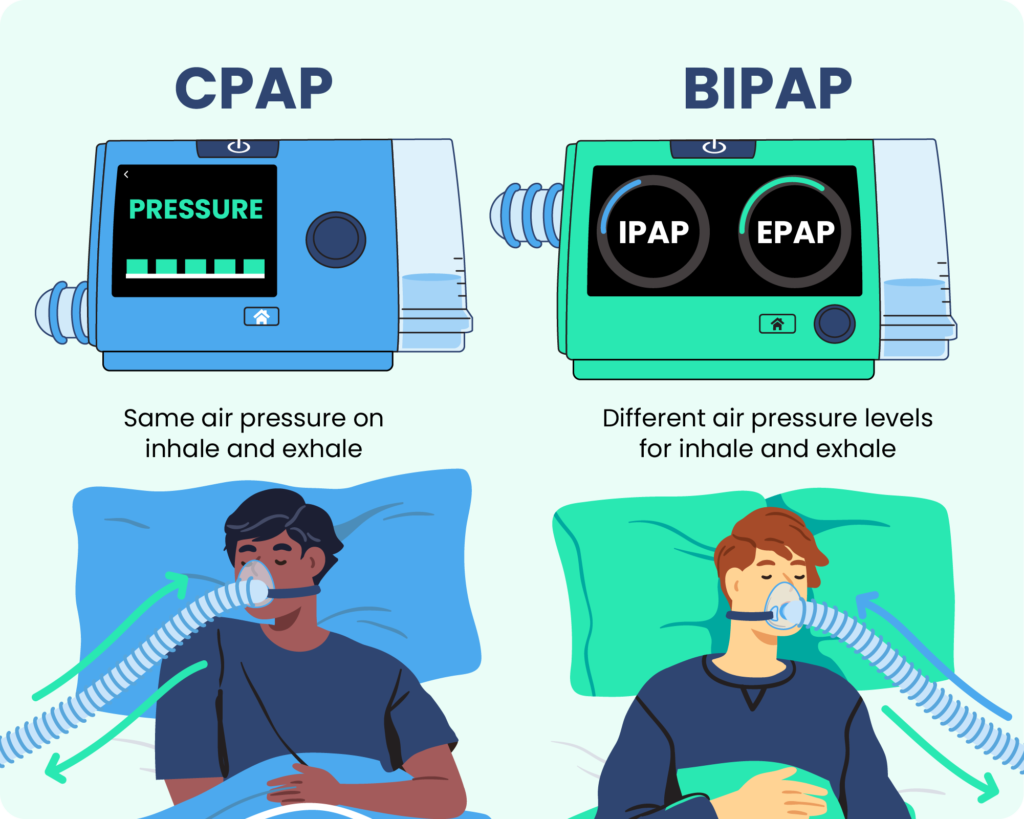
BiPAP machines have two pressure settings — inhalation positive airway pressure (IPAP) and exhalation positive airway pressure (EPAP) — that allow for lower pressure levels during exhalation. Depending on the BiPAP machine’s settings, the switch between IPAP and EPAP may be timed or automatically based on the user’s breathing patterns. BiPAP machines have a typical pressure range of 4 to 30 cm H2O. Both BiPAP and CPAP settings must be determined in an overnight sleep study, or polysomnography.
There are portable CPAP machines designed for travel, while BiPAP machines are designed for at-home use. Because BiPAP machines require additional sensors and settings, they are usually more expensive than an otherwise similar CPAP machine.
Different types of PAP therapy work better for different conditions, though there is some overlapTrusted SourceNational Library of Medicine, Biotech InformationThe National Center for Biotechnology Information advances science and health by providing access to biomedical and genomic information.View Source. CPAP therapy is generally recommended for obstructive sleep apnea (OSA), and sleep specialists are unlikely to place someone with OSA on BiPAP unless they cannot tolerate CPAP treatment. While some insurance providers cover both CPAP and BiPAP for OSA, those that do usually require proof that CPAP treatment is inadequate or not tolerated before reimbursing for a BiPAP machine. BiPAP therapy is primarily used to treat central sleep apnea (CSA), as well as heart, lung, and neurological disorders that require structured airway support during sleep.
Both CPAP and BiPAP machines are available with a range of accessories, both integrated and after-market. The most common are data collection features and climate control features like humidifiers and heated tubing.
CPAP
BiPAP
Typical Cost
$500-$1000
$1,700-$3,000
Pressure Levels
1
2
Typical Pressure Range
4 to 20 cm H2O
4 to 30 cm H2O
Insurance Coverage
May be covered
May be covered if CPAP therapy fails or is contraindicated
CPAP Basics
A continuous positive airway pressure (CPAP) machine directs pressurized air — usually set between 4 and 20 cm H2O — into a user’s airwayTrusted SourceNational Heart, Lung, and Blood Institute (NHLBI)The NHLBI is the nation's leader in the prevention and treatment of heart, lung, blood and sleep disorders.View Sourcewhile they sleep. This pressure keeps air passages open and ensures the user can breathe properly, allowing them to avoid the pauses in breathing (or apneas) that are the primary symptom of sleep apnea.
CPAP machines continuously pump air at one pressure setting rather than varying in pressure between the inhale and exhale, which can cause some people to feel as though they cannot exhale properly or that they are choking. Most users adjust to CPAP relatively quickly, while others find BiPAP easier to tolerate.
Unlike BiPAP machines, CPAP machines are available in a range of sizes. The most common type is intended to be used at home and is slightly smaller than a shoebox, while travel versions may be small enough to fit in the palm of your hand. Travel models sometimes have backup batteries for use while camping, and FAA-approved models are available for use on planes.
BiPAP Basics
Bilevel positive airway pressure machines have distinct air pressure settings for inhalation (IPAP) and exhalation (EPAP). The EPAP setting is usually significantly lighter than the IPAP setting, allowing users to breathe more naturally and not feel as though they are fighting against the machine when they exhale. Most BiPAP machines have a range of approximately 4 to 30 cm H2O.
BiPAP machines have up to three settings for the switch between IPAP and EPAP.
Spontaneous: Spontaneous switching automatically senses the user’s breathing pattern and switches between the two pressure levels when they naturally inhale and exhale. The majority of BiPAP users rely on this setting, and it is standard for BiPAP devices.
Timed: Timed switching allows users to program how long each IPAP and EPAP phase should last. This ensures users take the correct number of breaths per minute and can function much like a ventilator.
Spontaneous/timed: This setting is primarily spontaneous, following the user’s natural breathing patterns. On this setting, timed switching turns on when the machine senses that the user has dropped below a set number of breaths per minute.
Additionally, BiPAP machines can be fixed or auto-adjusting.
Fixed: The IPAP and EPAP settings of a fixed BiPAP machine are pre-set and do not change throughout the night.
Auto-adjusting: An auto-adjusting BiPAP machine has a range set for both IPAP and EPAP. This allows the machine to adjust automatically throughout the night in response to how the sleeper is breathing.
BiPAP vs CPAP: Which Is Best for You?
Although CPAP and BiPAP machines may seem similar, their differences can have a significant impact on your treatment. Because of this, the decision to switch from one to another should always be made with your health care team.
CPAP users usually have an adjustment period before they feel comfortable using their machines. Discomfort can be managed by adjusting settings, experimenting with climate control accessories or different mask types, or using a machine that slightly reduces air pressure on the exhale. BiPAP treatment is available for patients who do not tolerate CPAP therapy, but this switch must be decided on and supervised by a sleep specialist.
Related News
CPAP Adherence Tied to Fewer Days of Cold Symptoms March 31, 2023 – A study found that adherence to continuous positive airway pressure (CPAP) therapy may make viral infections less severe in people with obstructive sleep apnea.
Medically Reviewed by Dr. Anis Rehman, Internal Medicine Physician
People who are diagnosed with a sleep-related breathing disorder are often prescribed a treatment called positive airway pressure (PAP) therapy Trusted SourceUpToDateMore than 2 million healthcare providers around the world choose UpToDate to help make appropriate care decisions and drive better health outcomes. UpToDate delivers evidence-based clinical decision support that is clear, actionable, and rich with real-world insights.View Source. Although there are multiple ways of delivering PAP therapy, continuous positive airway pressure (CPAP) is a common sleep apnea treatment.
Consistent use of a CPAP machine provides both short- and long-term benefits to people diagnosed with sleep apnea. Learn about using a CPAP machine, choosing the right machine for you, and tips to help you get the most out of CPAP therapy.
What Is a CPAP Machine?
A CPAP machine is a bedside device that delivers positive airway pressure Trusted SourceNational Heart, Lung, and Blood Institute (NHLBI)The NHLBI is the nation's leader in the prevention and treatment of heart, lung, blood and sleep disorders.View Sourceand is used to treat obstructive sleep apnea (OSA) and other breathing problems. People with OSA experience an abnormal number Trusted SourceAmerican Academy of Sleep Medicine (AASM)AASM sets standards and promotes excellence in sleep medicine health care, education, and research.View Sourceof shallow breaths or complete lapses in breathing while asleep. Abnormal nighttime breathing can result in snoring, daytime tiredness, nighttime awakenings, and a variety of other health complications Trusted SourceNational Heart, Lung, and Blood Institute (NHLBI)The NHLBI is the nation's leader in the prevention and treatment of heart, lung, blood and sleep disorders.View Source.
CPAP therapy may also be prescribed to treat central sleep apnea (CSA) Trusted SourceUpToDateMore than 2 million healthcare providers around the world choose UpToDate to help make appropriate care decisions and drive better health outcomes. UpToDate delivers evidence-based clinical decision support that is clear, actionable, and rich with real-world insights.View Source, another sleep-related breathing disorder. In people with CSA, breathing slows or stops due to a lapse in the signals from the brain Trusted SourceMedline PlusMedlinePlus is an online health information resource for patients and their families and friends.View Sourcethat regulate breathing.
To help reduce periods of abnormal breathing in people with sleep apnea, a CPAP machine pushes air into a person’s airway, keeping it open as they sleep. As a result, sleepers treated with CPAP should experience fewer obstructive apneas Trusted SourceMerck ManualFirst published in 1899 as a small reference book for physicians and pharmacists, the Manual grew in size and scope to become one of the most widely used comprehensive medical resources for professionals and consumers.View Sourceand central apneas during sleep.
A CPAP machine operates by pushing air through a tube into a sleeper’s nose, mouth, or both as they sleep. This air applies pressure to the airway, reducing the likelihood the airway will collapse and obstruct breathing. With a traditional CPAP machine, air is pushed out continuously at one fixed rate of pressure.
CPAP machines are not the only machines that can provide positive airway pressure. Understanding the differences among the various machines that deliver PAP therapy may help shed light on why a certain type of machine is recommended by a doctor or sleep specialist.
CPAP Vs APAP Machines
CPAP machines may deliver air at a fixed rate, or may continually change the rate of airflow based on internal technology that senses changes in a person’s breathing during sleep. When a CPAP machine emits air at varying levels of pressure, it is called an auto-titrating CPAP (APAP or auto-CPAP).
Instead of emitting a fixed rate of air, an APAP machine senses when a person’s airway is likely narrowed or blocked, then increases pressure to open the airway. On average, an APAP delivers air at a lower rate than a CPAP machine that uses a fixed rate of airflow. As a result, people using an APAP may be better able to tolerate therapy.
BiPAP Vs CPAP
Unlike a fixed-rate CPAP machine that delivers air at a constant pressure, a bilevel positive airway pressure (BiPAP or BPAP) machine pushes out air at different rates, depending on whether a sleeper is breathing in or breathing out. Generally, the rate of airflow is higher as a person inhales and lower as a person exhales.
In addition to releasing air at two fixed rates of airflow, some BiPAP machines are capable of releasing air at an adaptable rate based on what the machine determines is necessary to reduce abnormal breathing. In these instances, the machine is called an auto-titrating BiPAP.
Generally, a CPAP machine is the first type of treatment prescribed to a person with obstructive sleep apnea (OSA). BiPAP may be recommended to people with OSA who do not respond well to a CPAP machine. BiPAP therapy may also be prescribed to people who have both OSA and another type of sleep-disordered breathing.
CPAP Vs ASV
An adaptive servo-ventilation (ASV) machine is primarily used to treat people with central sleep apnea when a CPAP machine is not effective in reducing abnormal breathing . Like a BiPAP machine, an ASV releases air at different rates of pressure when a person breathes in and when they breathe out. Also, the machine delivers air at a pre-set rate of pressure when it detects the person has stopped breathing.
Like APAP and some BiPAP machines, ASV machines can also be auto-titrating. The auto-titrating ASV machines use technology to determine how much air a sleeper needs to keep their airway open as they breathe out. As a result, the auto-titrating ASV machines release air at varying pressure during exhales.
Components of CPAP Machines
Although CPAP machines can vary somewhat depending on the manufacturer, they generally contain these components Trusted SourceNational Center for Biotechnology InformationThe National Center for Biotechnology Information advances science and health by providing access to biomedical and genomic information.View Source:
Mask: A mask sits over the sleeper’s nose or both their nose and mouth, creating a seal so air can be pushed into the airway without escaping.
Mask straps: Straps help keep the mask in position, so it remains on a person’s face as they sleep.
Tubing: A plastic tube or hose connects the mask to the CPAP machine’s motor that pushes out air. Air moves from the machine, through the tube, and into the mask and the airway.
Motor: The CPAP machine motor blows air into the connected tube. Most machines must be plugged into an electrical outlet to power the motor, but some battery-operated CPAP machines are available. The motor component of the machine also often contains an air filter and, in some cases, a heated humidifier.
Types of CPAP Masks
CPAP masks designed for at-home use come in a variety of styles. A doctor can help choose the mask that offers the best fit Trusted SourceMedline PlusMedlinePlus is an online health information resource for patients and their families and friends.View Source.
Nasal mask: A nasal mask pumps air through a mask that covers just the nose.
Nasal pillow: A nasal pillow delivers air through two prongs that extend into the nose Trusted SourceNational Library of Medicine, Biotech InformationThe National Center for Biotechnology Information advances science and health by providing access to biomedical and genomic information.View Source.
Full face mask: Most full face masks cover the nose and the mouth, but some may cover the full face.
Oral mask: An oral mask is an uncommon style that covers just the mouth.
While not typically used in a person’s home, other types of CPAP masks may be used in hospitalized patients. For example, a nasopharyngeal mask involves inserting tubes into the nose that extend into the throat.
Benefits of CPAP Machines
The primary benefit of using a CPAP machine is a reduction in episodes of abnormal breathing Trusted SourceUpToDateMore than 2 million healthcare providers around the world choose UpToDate to help make appropriate care decisions and drive better health outcomes. UpToDate delivers evidence-based clinical decision support that is clear, actionable, and rich with real-world insights.View Sourceduring sleep. As a result, CPAP therapy may improve symptoms associated with sleep-disordered breathing, resulting in:
Improved sleep quality
Reduced snoring
Less daytime sleepiness
Increased work productivity
Improved mood
Consistently using a CPAP machine overtime can provide additional benefits. For example, CPAP use may:
Lower high blood pressure
Reduce risk of stroke
Improve memory
Improve cognitive ability
Potential Side Effects
Although CPAP machines are very useful for treating sleep-disordered breathing, many people do not use their prescribed machine as much as recommended. Using a CPAP machine may produce side effects, such as:
Congestion
Runny nose
Irritated eyes
Dry mouth
Sore throat
Nosebleeds
Redness or irritation on top of the nose
Bloating or nausea
Respiratory infection
When a person first begins using a CPAP machine, they might find the mask uncomfortable. They may also feel embarrassed or claustrophobic while wearing it. A person’s doctor or sleep specialist can help to minimize side effects by making adjustments or trying another mask type, or by offering suggestions to make using a CPAP machine more comfortable.
Tips for Comfortably Using a CPAP Machine
Fortunately, there are ways to make using a CPAP machine feel more comfortable if you experience discomfort or side effects at first.
Ask about a humidifier: If your CPAP machine does not have a heated humidifier, switching to one that does may reduce the likelihood of dry mouth, nosebleeds, and congestion.
Try another mask: There are multiple styles of CPAP masks. If one feels uncomfortable or allows air to escape, another type might be a better fit.
Clean your CPAP machine: Be sure to clean your machine regularly, as directed by the manufacturer. A clean machine can reduce the chance of infection.
Adjust machine settings: If you have trouble sleeping because the air coming out of the CPAP machine feels too forceful, see your sleep specialist. They may adjust the airflow rate or have the machine begin at a lower rate and ramp up over time.
Consider an APAP machine: When the air of a fixed-rate CPAP feels uncomfortable, an APAP machine that automatically adjusts the rate of airflow to your needs might be a better fit.
Wear earplugs: If the sound of your CPAP machine makes it difficult for you to fall or stay asleep, consider wearing earplugs to block out the sound.
How to Select the Right CPAP Machine for You
CPAP machines are classified as medical devices, so they are only available with a prescription Trusted SourceAmerican Academy of Sleep Medicine (AASM)AASM sets standards and promotes excellence in sleep medicine health care, education, and research.View Source. If you are diagnosed with sleep-disordered breathing and your doctor or sleep specialist wants you to try CPAP therapy, they will likely prescribe the best CPAP machine for you. Of course, you can ask questions and give feedback if you feel the machine they choose is not a good fit.
Frequently Asked Questions About CPAP Machines
How Much Do CPAP Machines Cost?
CPAP machines range from about $500 to $1,000 or more. Optional features like a heated humidifier can add to the cost of a CPAP machine.
Health insurance may cover some or all of the cost of a CPAP machine. Check with your insurance provider or doctor to learn how much you would have to pay out-of-pocket for a CPAP machine. Follow-up visits with a doctor or sleep-specialist may be required for continued coverage of your CPAP machine.
Does Medicare Cover CPAP Machines?
If you are diagnosed with obstructive sleep apnea and both your doctor and CPAP supplier are enrolled in Medicare, then Medicare will cover some of the cost of your CPAP machine. Initially, they may only cover a three-month trial, then require additional doctor’s visits before continuing coverage. You may still have to pay out-of-pocket for 20% of the cost of a CPAP machine and accessory supplies, like the mask and tube.
How Can I Get a CPAP Machine?
The first step in getting a CPAP machine is to see a doctor to learn if CPAP therapy is right for you. After an initial evaluation, a doctor may refer you to a sleep specialist, who can order a sleep study if they suspect you have a form of sleep-disordered breathing. If the sleep study confirms that you could benefit from CPAP therapy, your sleep specialist or doctor will instruct you on how to select and purchase a CPAP machine.
How Do CPAP Machines Know When You Stop Breathing?
A fixed-air CPAP releases air at a constant rate of pressure, regardless of whether or not you are breathing normally or experiencing a lapse in breathing. An APAP machine uses sensors and technology to determine when a person has slowed or stopped breathing. Then, the APAP adjusts its airflow accordingly.
Since an APAP machine can detect when a person has stopped or slowed their breathing, it can also provide an estimate of how many abnormal breathing events a person experiences per night and per hour. The machine can also detect when the mask is leaking air.
Related News
CPAP Adherence Tied to Fewer Days of Cold Symptoms March 31, 2023 – A study found that adherence to continuous positive airway pressure (CPAP) therapy may make viral infections less severe in people with obstructive sleep apnea.